

By The Ooheleth
Many of those crying of being politically marginalized are doing so for their personal and selfish interests and not for the interest of such tribe. Marginalization is defined as treatment of a person or group as insignificant or peripheral. This treatment could be in the areas of education, politics, economy, social integration and religion. Some groups in Nigeria have been clamouring that they have been marginalized. For us to actually justify this agitation, we need to look at the population of the tribes in Nigeria. Out of over 250 million Nigerians today made up of about 371 tribes, about 30% of the total populations are Hausas, 15% are Yorubas, 15% are Igbos, and about 6% are Fulanis while the other 367 tribes constitute the remaining 34%.
All the states are constituted by the 371 tribes in the country. These numbers are represented at every segment of the government. Apart from the State and Local governments, the tribes are represented through their constituencies at the National Assemblies. The Federal Executive Council is made up of Ministers appointed from every state of the federation which meets up the federal character as stated in the constitution. In a democracy, there are representations at every level of government. In consideration of this analysis, and according to the constitution, all tribes can be said to be represented and not marginalized politically.
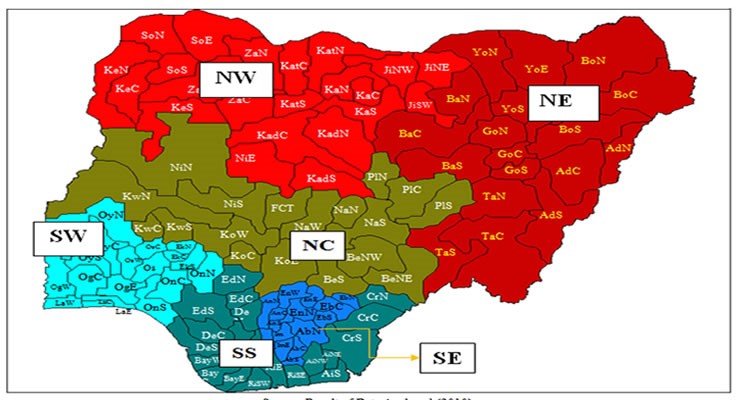
If there are tribes said to be marginalized in the country, they are the minor ones. The South East cannot be said to be constitutionally marginalized in the current democratic structure. The tribe is represented at the three tiers of government as well as the three arms of government. In a democracy, a president is neither singly appointed by a group of people, rotated nor zoned to a particular region. A presidential candidate according to the constitution usually emerges from a political party made up of Nigerians irrespective of tribe and religion. Such candidate would contest with others and must have a good percentage of votes from all the regions in the country. This shows that only one tribe or zone cannot singly produce a candidate despite their number. It also protects the minority groups from been subdued by the larger ones. Rotation and zoning therefore is not democratic and unconstitutional.
While some tribes are blessed with one gift, others may not be richly blessed like others. The best way to manage the situation is to create an equal opportunity as stated in the Nigerian constitution. Since the history of the democracy in Nigeria, no president has been produced by a single tribe. Despite having a large number of votes from a particular region, and having more number of votes than other candidates as a result of this, Chief Obafemi Awolowo could not be declared president in 1983 because his votes did not represent the regions as stated in the constitution. Despite the number of votes gathered by President Muhammadu Buhari from the Northern region in the previous elections, he could not become the president till he got the required number of votes from other parts of the country.
Even though the political parties may consider the tribe of the candidates before presenting them, it is illegal to ask all tribes to step down for a particular tribe in a presidential election because such tribe has been marginalized. Meanwhile, as stated earlier, the only tribe that can show evidence of political marginalization are the minority tribes.
Political appointments are based on the political party policies and agreements. They usually appoint their members to assist in carrying out their electoral manifestoes. Appointments of leaders of government agencies and heads of armed forces have a standard process. This usually involves the three arms of government. This is to ensure that people are not marginalized. Such appointments are presented by the agencies, recommended by the executive arm, approved the legislative arm and sworn in by the judiciary.
Public offices are competitive and should not be based on tribe or religion. Every tribe can produce quality leaders who are needed for good governance. Using marginalization as a yardstick for electing or choosing a President of this country means that the national wealth is being shared among tribes (National Cake Syndrome). Who is actually marginalizing who and at what point and in which sector? Those who are complaining that they are marginalized are doing so for selfish interests. Even if they are appointed based on their tribe, they won’t represent such tribes on whose wings they rode to power. They cannot therefore be pacified by granting them the presidential ticket on a platter. It will lead to further clamour from other tribes.
Every Nigerian leader should work towards a common goal and for the benefit of all Nigerians. Let those who feel marginalized go into full electoral process by joining political parties, lobby other regions and tribes for political positions and power and not use the social media to impose their tribe on others. We need de-tribalized leaders who would use Nigerian wealth for the development of every Nigerian and Nigeria.


