
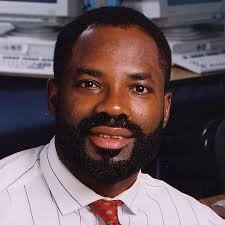
Nigeria born Philip Emeagwali has been listed among the top 10 most intelligent people in the world. He has the 9th slot directly below Marilyn Vos Savant, 8th with verified IQ of 190 and directly above 10th placed Garry Kasparov who is alleged to have an IQ of 190.
Philip Emeagwali, of course, is a renowned and world-acclaimed engineer, mathematician, computer scientist and geologist who was one of two winners of the 1989 Gordon Bell Prize, a prize from the Institute of Electrical and Electronics Engineering (IEEE), for his use of a Connection Machine supercomputer to help detect petroleum fields.
The Igbo-born Nigerian is credited for inventing a formula that allows supercomputers powered by thousands of processors to perform billions of calculations per second, a discovery that made international headlines and inspired the reinvention of supercomputers.
The supercomputer comprises of thousands of networked computers and the Internet also comprises of millions of networked computers. The supercomputer spawned the Internet.
Emeagwali’s 1970s hypothesis on 64,000 networked computers around the Earth led to his programming of 64,000 processors inside a big box to perform 3.1 billion calculations per second, a world record in 1989. For the latter achievement, he won the 1989 Gordon Bell Prize, which is the “Nobel prize of supercomputing.”
Philip Emeagwali was born on the 23rd of August 1954 in Akure, Nigeria. He was raised in Onitsha in the South Eastern part of Nigeria. His early schooling was suspended in 1967 as a result of the Nigerian Civil War. At age 13, he worked in the Biafran army. After the war he completed high-school equivalence through self-study.
He traveled to the United States to study under a scholarship following completion of a course at the University of London. He received a bachelor’s degree in mathematics from Oregon State University in 1977. He later moved to Washington D.C., receiving in 1986 a master’s degree from George Washington University in ocean and marine engineering, and a second master’s in applied mathematics from the University of Maryland.
Emeagwali studied for a Ph.D. degree from the University of Michigan from 1987 through 1991. His thesis was not accepted by a committee of internal and external examiners and thus he was not awarded the degree. Emeagwali filed a court challenge, stating that the decision was a violation of his civil rights and that the university had discriminated against him in several ways because of his race. The court challenge was dismissed, as was an appeal to the Michigan state Court of Appeals.
In 1989, Emeagwali won the $1000 Gordon Bell Prize for an application of the CM-2 massively-parallel computer. The application used computational fluid dynamics for oil-reservoir modeling. He received a prize in “price/performance” category, with a performance figure of about 400 Mflops/$1M. Mobil Research and Thinking Machines used the CM-2 for seismic data processing and achieved the higher ratio of 500 Mflops/$1M. The judges decided on one award per entry. His method involved each microprocessor communicating with six neighbors.
Emeagwali’s simulation was the first program to apply a pseudo-time approach to reservoir modeling. He was cited by Bill Clinton as an example of what Nigerians can achieve when given the opportunity and is frequently featured in popular press articles for Black History Month.