

Science has unveiled new discoveries about the cosmos, biologists etched out a clearer map of our planet’s creatures, and paleontologists painted a richer picture of the dinosaurs that roamed Earth millions of years ago. The latest compendium of humanity’s scientific research continues to intrigue and reveal new mysteries to solve.
ASTRONOMERS DETECT IMMENSE RIPPLES IN THE FABRIC OF SPACE-TIME
For the first time, scientists detected low-frequency gravitational waves moving through the galaxy. These cosmic ripples are likely the distant echoes of supermassive black holes interacting and merging many billions of light-years away. A consortium of international researchers discovered these cosmic waves by measuring tiny time variations in radio signals from pulsar stars. The findings suggest that there were far more behemoth black holes in the early universe than previously thought, and continuing to study this new type of gravitational wave could help unravel details about the origins of our universe and better explain the unseen substances and forces that power the cosmos.
BRAIN DECODER TRANSLATES HUMAN THOUGHTS—PROVIDING HOPE FOR THOSE WHO’VE LOST SPEECH
Though it’s not technically a “mind reading” device, University of Texas at Austin researchers reported revolutionary work with their new AI-based system—translating a person’s brain activity into a continuous stream of text in the lab. This semantic decoder doesn’t require a surgical implant, but instead it relies on functional MRI scans to pick up brain activity in response to things like podcasts or images. Rather than provide word-for-word transcripts, the brain decoding system essentially creates a dictionary of brain activity patterns based on how an individual responds to certain words or images and then uses that dictionary to cross-reference brain activity to other things that the person is thinking about. This tech, which relies on AI language generation algorithms, is currently in its early days, though it’s already raised thorny questions about mental privacy and ethics in non-voluntary situations. For the families of people with communication impairment, however, the work provides new hope.
ANCIENT WHALE MIGHT BE LARGEST ANIMAL EVER
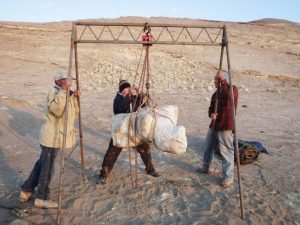

Could this have been the biggest animal ever? A new analysis of Perucetus colossus fossils from southern Peru suggests that this ancient animal was approximately 60-feet-long and weighed more than 300 tons.
Move over blue whale—an ancient cetacean appropriately named the Perucetus colossus may have been the largest animal ever. A new analysis of fossil bones from the ancient whale that plied the waters along the coast of Peru more than 37 million years ago suggests that the animal may have weighed more than 300 tons and measured around 60 feet. If it was truly as heavy as scientists suspect, then it would have been the largest known animal to ever live. Blue whales, although still longer at around 100 feet, only weigh around 200 tons.
NUMBER OF DISCOVERED PLANETS RISES PAST 5,500
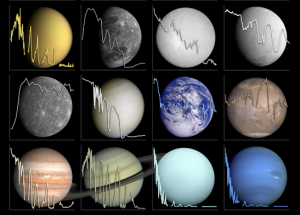

In August, roughly three decades after astronomers found the first planets outside our own solar system, scientists unveiled that they’d discovered six new exoplanets, pushing our total count of known planets above 5,500. The search for exoplanets, enabled by telescopes such as the Transiting Exoplanet Survey Satellite (TESS), continues to reveal a remarkable diversity of new worlds across the galaxy. What’s more, the James Webb Space Telescope and other powerful observatories are also providing more details about these worlds, such as K2-18 b—a planet between the sizes of Earth and Neptune that may have a global ocean beneath a thick atmosphere.
CHIMPS, LIKE HUMANS, EXPERIENCE MENOPAUSE
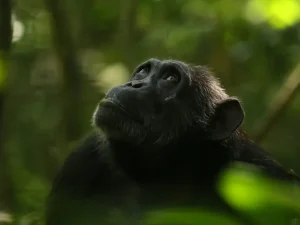

Female chimps have joined the short list of species that live long past their reproductive years.
Biologists have long puzzled over the evolutionary benefit of animals living long past their reproductive years. Only orcas, short-finned pilot whales, narwhals, beluga whales, false killer whales, and humans are known to experience menopause. But new work that drew upon robust, long-term analysis of hormones in chimpanzee urine confirms that chimpanzees in at least one locale, Uganda’s Kibale National Park, go through menopause and continue to live on. The urine studies, which included females age 14 to 67, indicate that the chimps experienced menopause around age 50, which provides an intriguing parallel for humans that often experience menopause around that same age. Evidence suggests that in some of the whale and dolphin species, elder females contribute to raising later generations, but that doesn’t appear to be the case with chimps since the animals don’t raise related offspring. One theory, however, is that menopause helps decrease breeding competition for the primates, something that scientists will continue to study in the years ahead.
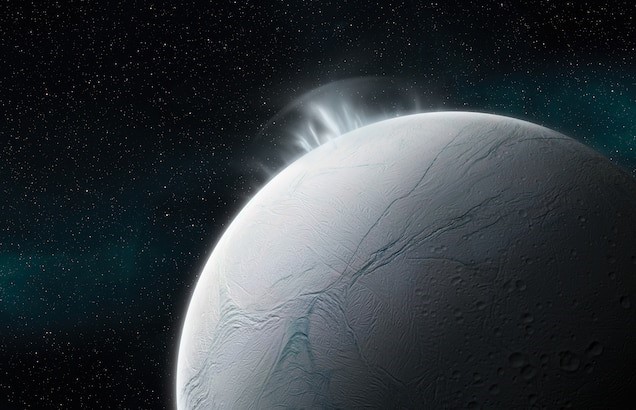
PHOSPHORUS DISCOVERED ON SATURN’S ENCELADUS, A CRUCIAL SIGN THAT LIFE IS POSSIBLE
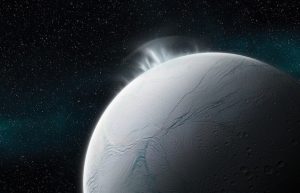

Saturn’s sixth-largest moon, Enceladus, is about as wide as the state of Arizona. It spews vapor plumes in this illustration, but recent analysis of icy grains on the distant rock indicate that it has phosphorous, an essential element for life.
New chemical evidence suggests Saturn’s moon may be capable of supporting life. Scientists this year announced that they’d found phosphorous in the ocean on Saturn’s sixth-largest moon, Enceladus. Alongside carbon, hydrogen, nitrogen, oxygen, and sulfur, this sixth element is essential for sustaining life. Already, astronomers had found signs of the other five elements on Enceladus, so this latest find—detected in ice grains scooped up by the Cassini spacecraft’s Cosmic Dust Analyzer—makes this icy rock a promising candidate for extraterrestrial life.
FARMERLESS FARMING
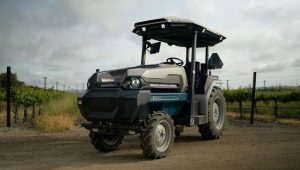
Monarch Tractor MK-V

The MK V tractor is the world’s first fully electric, self-driving tractor—poised to make the lives of farmers easier, safer, more sustainable, and more profitable. Its parent company, Monarch Tractor, estimates that a customer in California conducting mowing, tilling, and dicing can save $79,000 annually on fuel alone, and an additional $120,000 on labor thanks to automation. CEO and co-founder Praveen Penmesta says Monarch worked directly with farmers to make the MK-V “familiar, easy to use, and able to keep up with the rigors of farming.”


