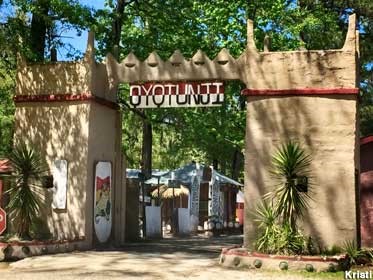
Oyotunji African Village is a kingdom located near Sheldon, Beaufort County, South Carolina in the United States of America. Oyotunji kingdom was named after the Oyo Empire, a pre-colonial Yoruba kingdom that lasted from the 1300s until the early 1800s in what is now southwestern Nigeria. The name literally means “Oyo̩ returns” or “Oyo̩ rises again.” This refers to the Nigerian Yoruba kingdom of Oyo, now rising in a new kingdom in the South Carolina of the US.
Oyotunji kingdom covers about 27 acres. It has a Yoruba temple which was moved from Harlem, New York to its present location in 1960. It was originally intended to be located in Savannah, Georgia, but was eventually settled into its current position after disputes with neighbors in Sheldon over drumming by tourists.
Oyo̩tunji was founded by His Royal Highness O̩ba (King) Waja, O̩funto̩la Oseijeman Adelabu Adefunmi I. Born Walter Eugene King on October 5, 1928, Oba O̩funto̩la Oseijeman Adelabu Adefunmi I, a Detroit native, began studying Afro-Haitian and ancient Egyptian traditions as a teenager. He was further influenced by his contact with the Katherine Dunham Dance Troupe in New York City at the age of 20, an African American modern dance troupe that drew from many cultures within the African Diaspora.
August 26, 1959, O̩ba Waja became the first African born in America to become fully initiated into the Oris̩a-Vodoo African priesthood by African Cubans in Matanzas, Cuba, and became known as Efuntola Osejiman Adefunmi. After his return to the United States, he formed the Yoruba Temple in Harlem in 1960. The temple, committed to preserving African traditions within an American context, was the cultural and religious forerunner of Oyotunji Village.
The story goes that when many Africans were taken into slavery abroad, some left with their culture and tradition which they continued within the foreign land where they found themselves. They continued with the culture and tradition of their fathers so as to maintain their identity.
The Yorubas in slavery were among the Africans that maintained their culture in the strange land and this was handed down to their children from generation to generation.
After the abolition of the slave trade, many of the Yorubas married children of their former masters thus bore children of mixed blood. Moreover, they established their culture in the foreign land since most of them could not trace their root back to Nigeria.
The Yoruba culture has been one of the prominent and most celebrated one throughout the world till date. O̩yo̩tunji is regarded as North America’s oldest authentic African village. It has survived 51years of sustaining the Yoruba traditional sociology and values in the diaspora.
This marked the beginning of the spread of the Yoruba religion and culture among African-Americans. He later founded the Sàngó Temple in New York and incorporated the African Theological Arch Ministry in 1960. The Sàngó Temple was relocated and renamed the Yoruba Temple.
With the rise of Black Nationalism in the 1960s, King began to envision the construction of a separate African American nation that would institutionalize and commemorate ancestral traditions. In June of 1970, he fulfilled this vision with the creation of Oyotunji African Village.
It was during this time that he also established a new lineage of the priesthood, Orisha Vodoo, to emphasize the tradition’s African roots. Today, over 300 priests have been initiated into this lineage and the African Theological Arch ministry, founded by Oba O̩funto̩la Oseijeman Adelabu Adefunmi I in 1966, now serves as the umbrella organization for the Village.
To further his knowledge of Yoruba culture, he traveled to Abeokuta in Nigeria in 1972 where he was initiated into the Ifa priesthood by the Oluwo of Ije̩un at Abeokuta, Ogun state, in August of 1972. He was later proclaimed Alase̩ (Oba-King) of the Yoruba of North America at O̩yo̩tunji Village in 1972.
In its early years, Oyotunji Village was home to as many as two hundred people. Today, its residential community consists of few African American families, governed by an Oba (king) and the community’s appointed council.
Each family is committed to the teachings of the Yoruba tradition, which include a religious understanding of the world as comprised primarily of the “energies” of the Supreme Being Olodumare, the Orisha deities, and the ancestral spirits. This religious world is maintained spiritually through rituals, chants, music, sacrifice, and annual ceremonies.
Oba Efuntola Osejiman Adefunmi passed away on Thursday, February 10th, 2005 at O̩yo̩tunji African Village in Beaufort County, South Carolina. Since Adefunmi’s death in 2005, the village has been led by his son, the fourteenth of twenty-two children of Oba Efuntola Osejiman Adefunmi, till date.